Case Studies
Four buildings. Four configurations. Four different goals. The same result: a building that heats itself cheaper, earns Bitcoin, and does both autonomously.

The Colorado Mountain Home
2,396 sq ft · Forced Air HVAC · Natural Gas Backup
A single water-cooled miner drops into the existing mechanical room, hot water circulates to a radiator inside the furnace return duct, and the air handler distributes heat exactly as the furnace would — silently, invisibly, and with Bitcoin earnings on top. The goal: maximize hashrate uptime during the heating season. Gas exists only for backup.
Results
System Details
- Single water-cooled miner in mechanical room
- Radiator installed in existing HVAC return duct
- Stage 1 heat handled entirely by miner — gas is stage 2 backup
- Home Assistant fires miner on thermostat call, triggers air handler blower
- Silent operation — no noise from miner, existing ductwork distributes heat
- Gas furnace nearly idle for the full heating season
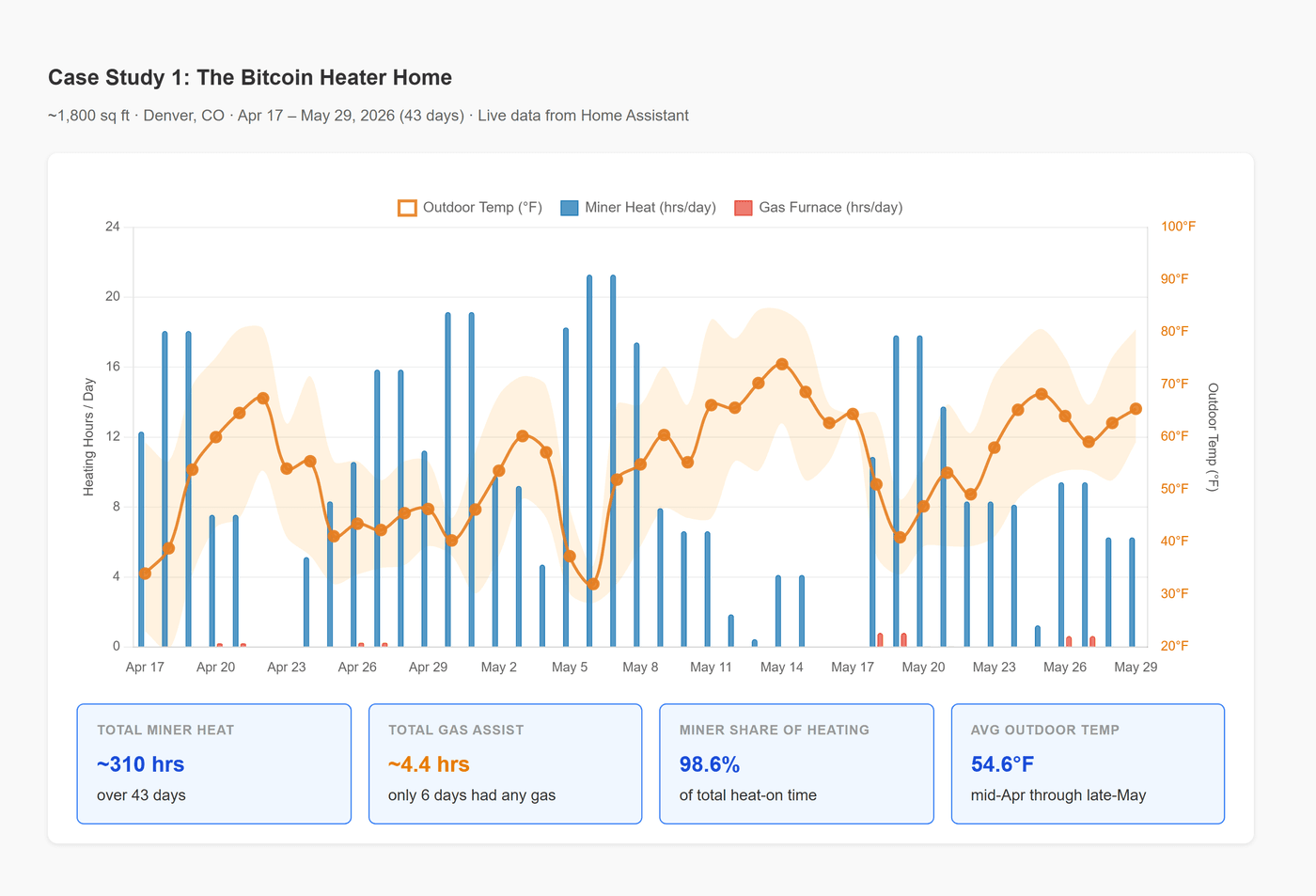
"A single properly sized miner can displace the dominant heating load of a 2,400 sq ft home in a cold climate."
The All-Electric Mountain Home
3,966 sq ft · Hydronic Radiant Floors · 40kW Electric Boiler · No Gas
The cleanest possible comparison: same electricity source, same delivered heat, different outcome. Two miners in an immersion tank replace a 40kW electric boiler as the primary heat source for radiant floors. No new thermostats, no new wiring, no contractor beyond a plumber — and a 45% reduction in effective heating cost.
Results
System Details
- Two 3,000W miners submerged in dielectric oil immersion tank
- Heat exchanger on radiant floor return loop — upstream of 40kW electric boiler
- Boiler senses warm water, stays off; miners handle the load
- No changes to existing thermostats, wiring, or zone controllers
- Boiler exists as backup for coldest days — rarely fires
- Only installation work: adding the thermal exchange tank to existing plumbing
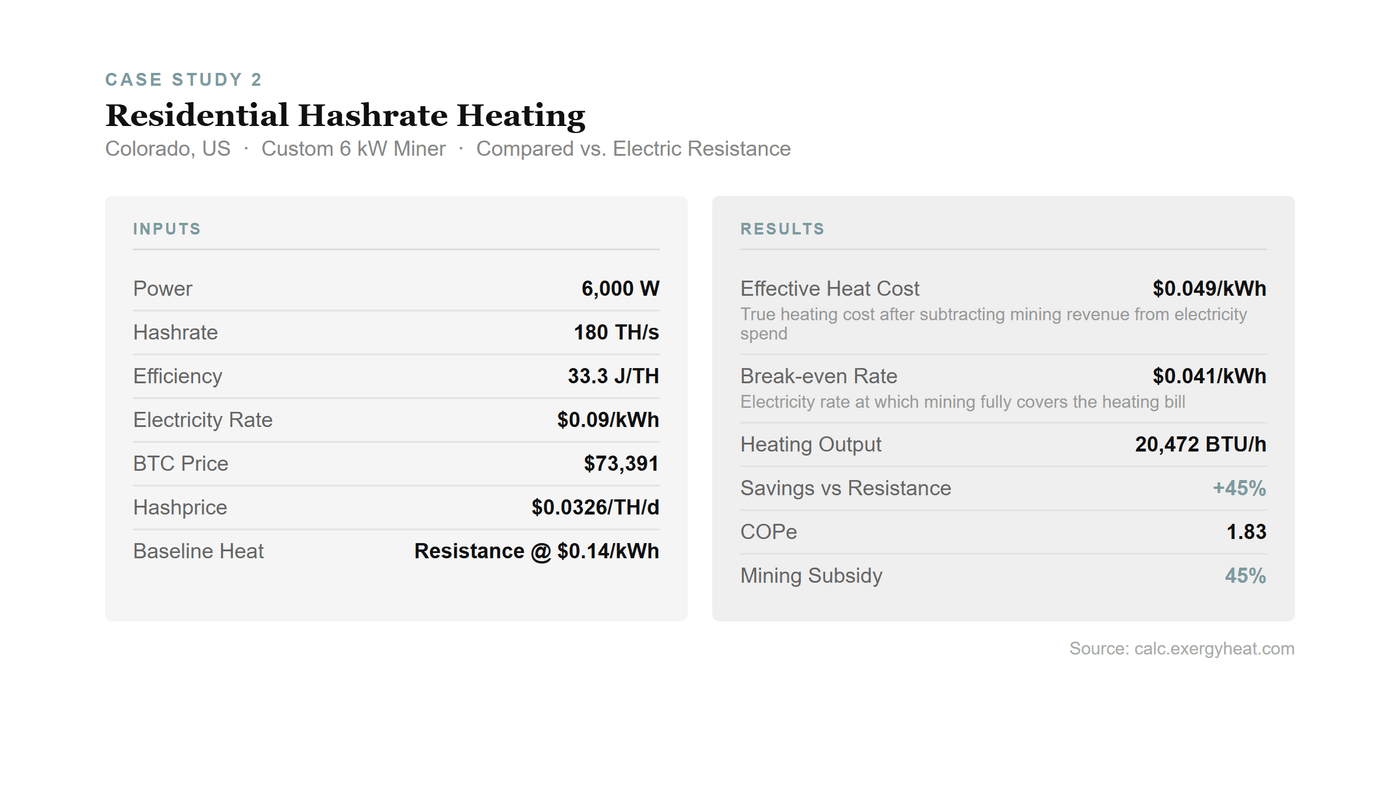
"At $0.14/kWh electricity, hashrate heat costs $0.049/kWh effective — a 45% reduction versus straight electric resistance at the same rate."
The Solar Home
900 sq ft · Zone Heaters + Garage Miner · Net Metering at $0.01/kWh
A failing furnace with a $10,000 replacement quote and a solar system exporting energy to the grid for a penny a kilowatt-hour. One system solved both problems: $4,000 installed, furnace replacement deferred indefinitely, and solar energy now earns 3.3× more routed through the miner than sent to the utility.
Results
System Details
- Three 800W mining space heaters — one per primary zone, each with wireless temp sensor
- Home Assistant virtual thermostats manage zone setpoints — no wall thermostat needed
- Garage miner connected to solar inverter: activates on excess generation, dumps heat outside
- Solar arbitrage runs automatically every day the sun produces more than the building needs
- Furnace did not trigger once during the heating season — miners handled the full load
- Over 57 days: same kWh earned 3.3× more through mining than exported to grid
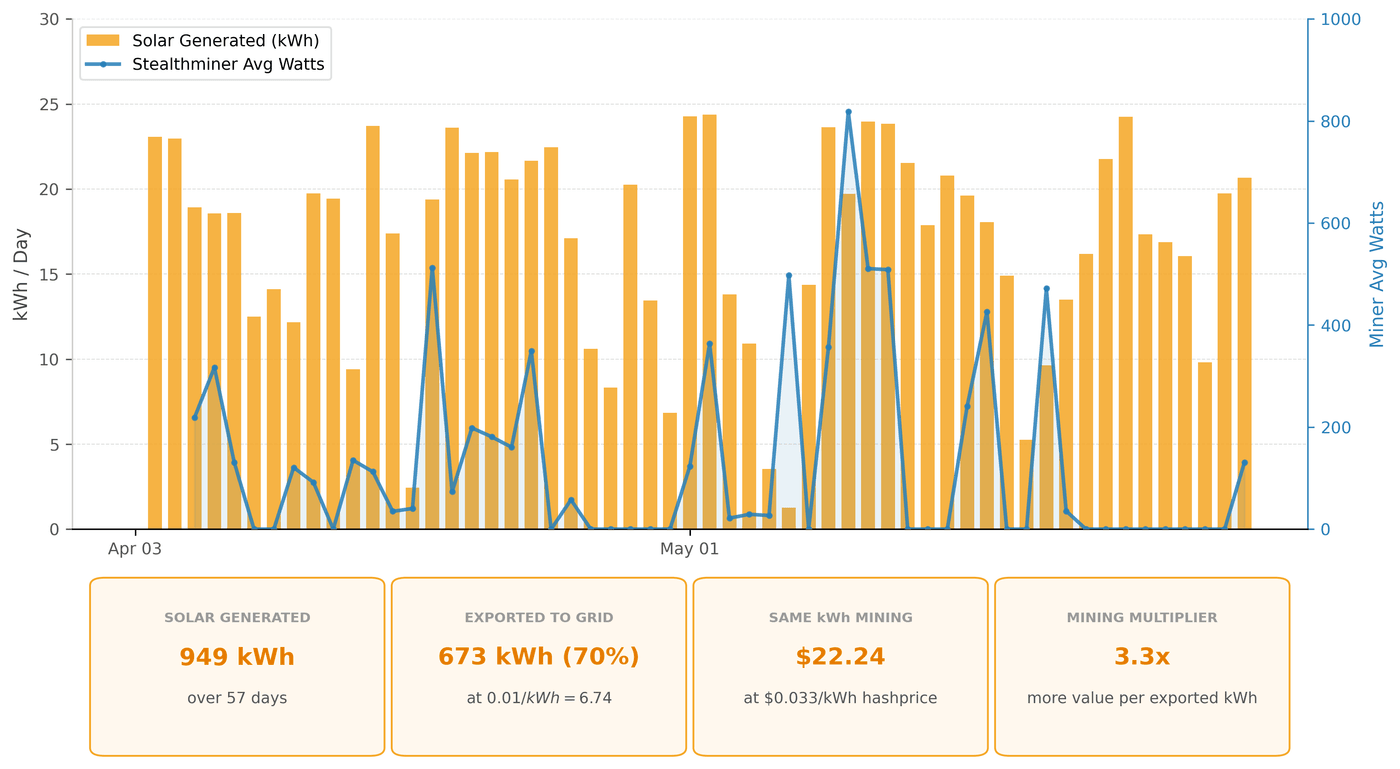
"The same energy that would have earned $6.74 exported to the grid at $0.01/kWh earned $22.24 routed through the miner — a 3.3× improvement per kWh."
The Commercial Building
5,250 sq ft · Three HVAC Zones · Large Solar Array · Commercial TOU Pricing
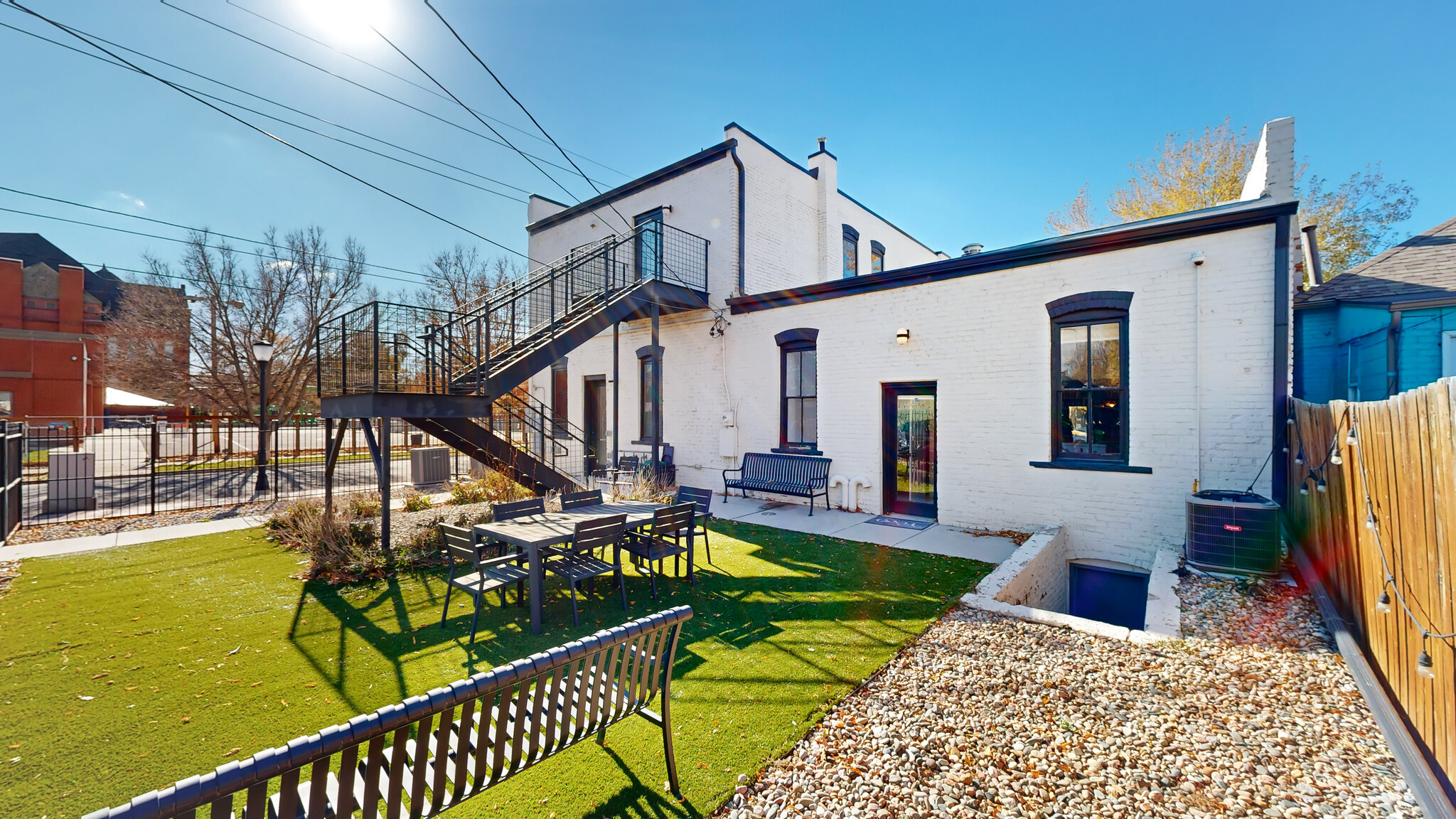
Exergy's Denver demo site and office. The most fully integrated building we operate — five miners across four zones, a liquid-cooled Bitcoin boiler on radiant floors, a Bitcoin-heated hot tub, solar-to-mining arbitrage, and a Home Assistant system that knows the cost of every energy input in real time and always routes heat through the cheapest one.
Results
System Details
- 4,000W liquid-cooled Bitcoin boiler on hydronic radiant floor system
- Three forced-air furnaces with miners in return ducts — gas is stage 3 backup only
- Bitcoin mining space heaters for individual office zones
- Bitcoin-heated hot tub running year-round off a dedicated miner
- Dry cooler in backyard for summer heat dump when building doesn't need heat
- HA reads TOU rate, solar output, Bitcoin economics, gas cost — picks cheapest BTU in real time
- Off-peak overnight: boiler often runs for pure profit, circulating to dry cooler
- All hardware controlled locally — no cloud dependency, no data leaving the network
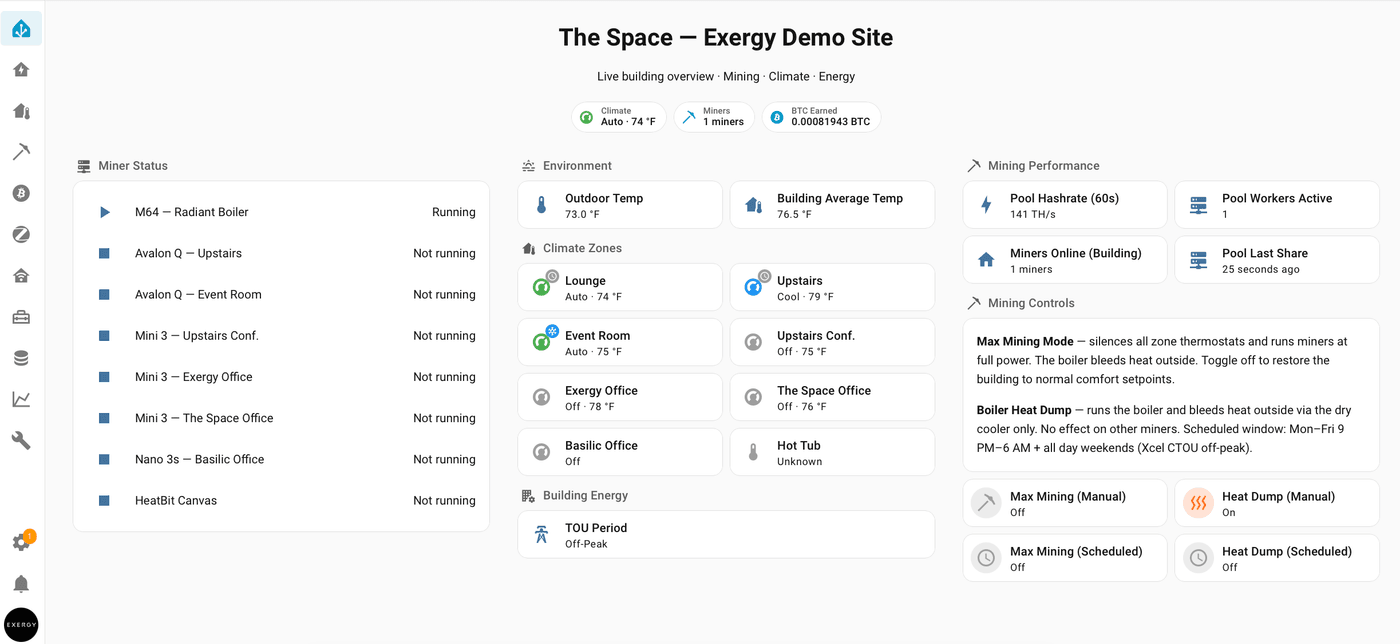
"Five miners across four zones. Every energy input visible. Every decision made automatically. Gas furnaces exist in the building but are rarely the cheapest option the system finds."
What These Installations Prove
The sizing methodology works. A miner sized to the average heating load, not the peak, runs at high duty cycle and handles the dominant share of heat demand. The existing system covers the rest. Across every install, the backup system rarely fired.
Hashrate heat is a viable alternative to conventional equipment upgrades. A $4,000 mining system extended the life of a furnace with a $10,000 replacement quote. A 6,000W immersion system displaced a 40kW electric boiler. In both cases, the mining system handled the load at a lower effective cost per BTU.
The whole building can be smart at the energy and economics layer. Home Assistant manages zone temperatures, operating modes, TOU rate response, and solar routing simultaneously. The building makes real-time economic decisions — which fuel is cheapest right now, where the heat is needed, should the excess generation mine or export.
That intelligence lives on hardware you own. No cloud dependency. No subscription. No vendor with access to your energy data. The automation logic runs locally, the data stays local, and the system keeps working if the internet goes down.
Want to see the math for your building?
Run the numbers yourself with our free calculator, or talk to us about what a system would look like for your specific setup.